
Cloud Mining.One Account.Every Screen.
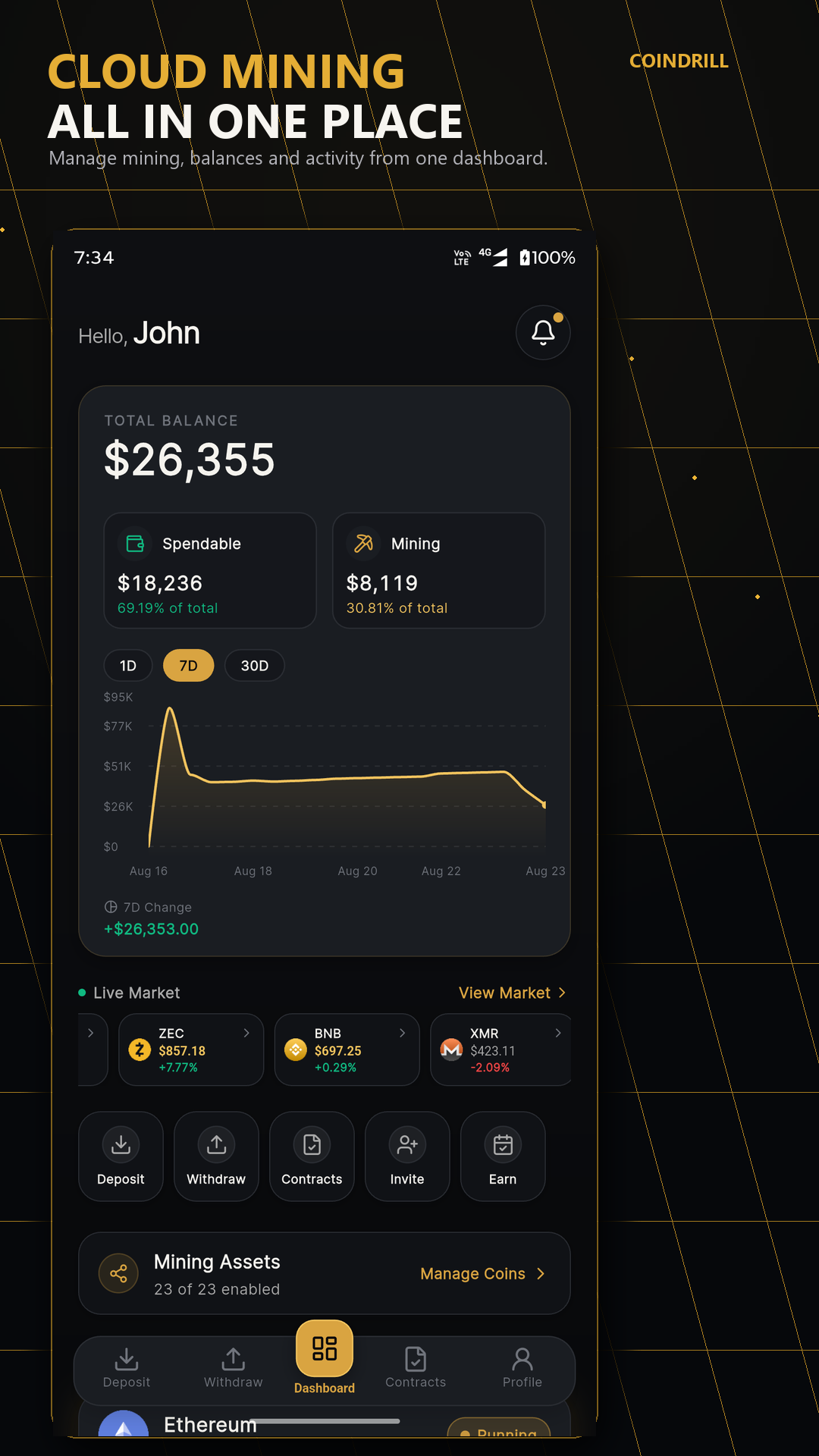
Manage cloud-mining contracts, monitor activity, and track your portfolio across Web, Android, and Windows — all in one place.
Mining-related computation runs remotely through the CoinDrill service. CoinDrill does not use your device CPU/GPU to perform cryptocurrency mining.




-
Remote Cloud Mining
Made Simple
-
Secure & Transparent
Always
-
Multi-Asset Support
BTC, ETH, LTC + more
What CoinDrill is
CoinDrill is software for managing cloud mining and related catalog activity. Users review offerings, activate contracts when available, watch working hashrate or activity signals, and use adjacent account features such as market context, funding flows, and promotional Earn modules where enabled. The product’s center of gravity is remote management — not consumer-device hashing.
That distinction is foundational. Many people searching for “crypto mining apps” encounter either industrial tools, educational explainers, cloud management products, or misleading local miners. CoinDrill’s positioning is intentional: open the client to control and observe service-side activity. Do not expect your handset CPU to compete with SHA-256 ASICs, Scrypt farms, RandomX fleets, Etchash rigs, or kHeavyHash hardware.
CoinDrill is also multi-asset by design. A dynamic catalog can include proof-of-work hashrate_allocation assets — Bitcoin and Bitcoin Cash (SHA-256), Dogecoin and Litecoin (Scrypt), Monero (RandomX), Ethereum Classic (Etchash), Kaspa (kHeavyHash) — alongside earnings_allocation assets whose base consensus is not ASIC PoW, such as Ethereum, BNB, Solana, Cardano, Avalanche, Polkadot, TRON, and XRP. Catalog adjacency must never erase consensus differences.
- Management platform for remote / catalog-defined activity
- No local CPU/GPU cryptocurrency mining on user devices
- Dynamic multi-asset catalog with accurate allocation classes
Live in-app catalog and contract terms override marketing summaries.
The cloud mining experience
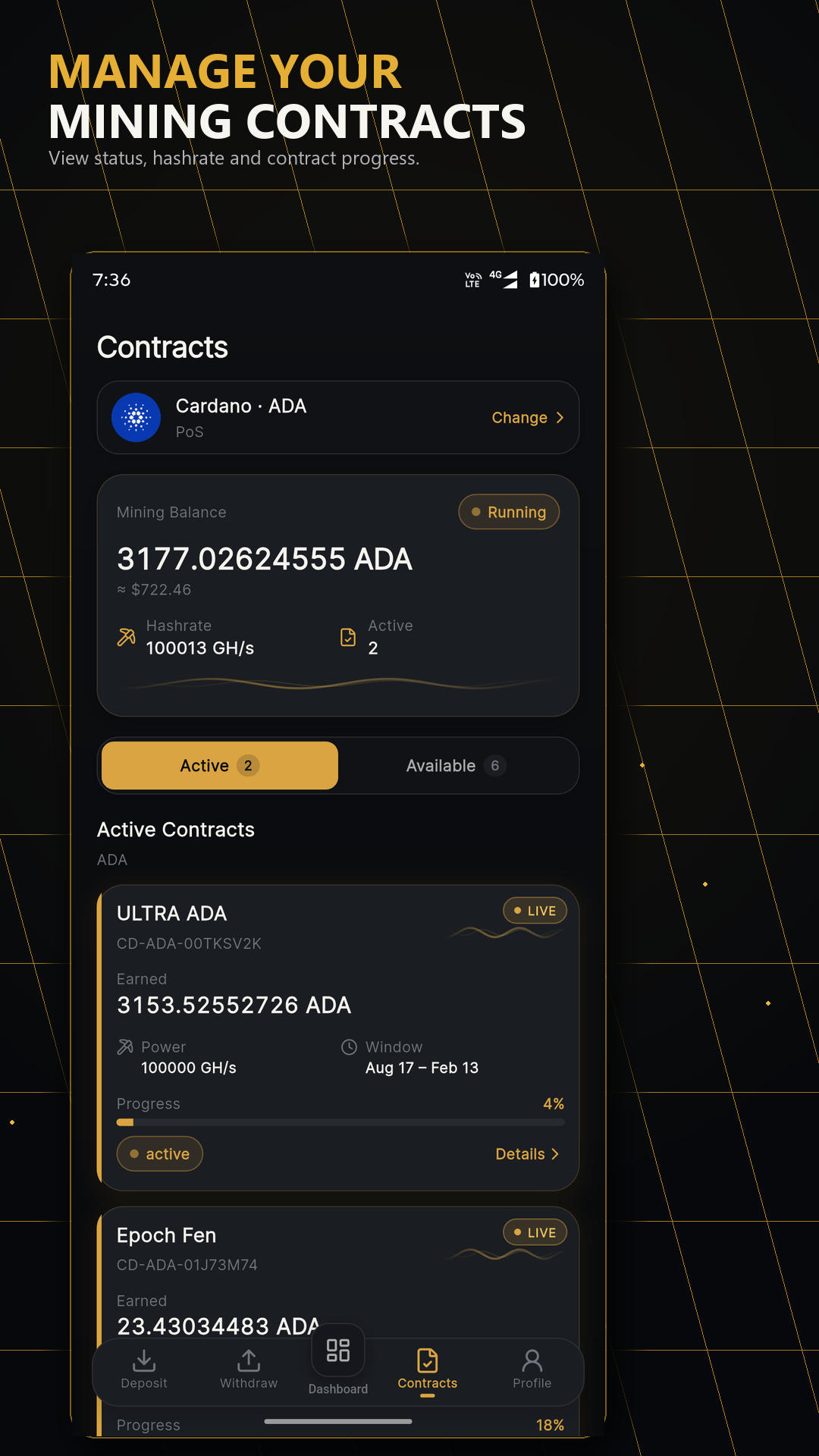
A typical journey begins with literacy, not urgency. Users learn what hashrate, difficulty, and rewards mean on proof-of-work networks, then open contract details to map those concepts onto commercial fields: asset, duration, capacity metric, fees, and status rules.
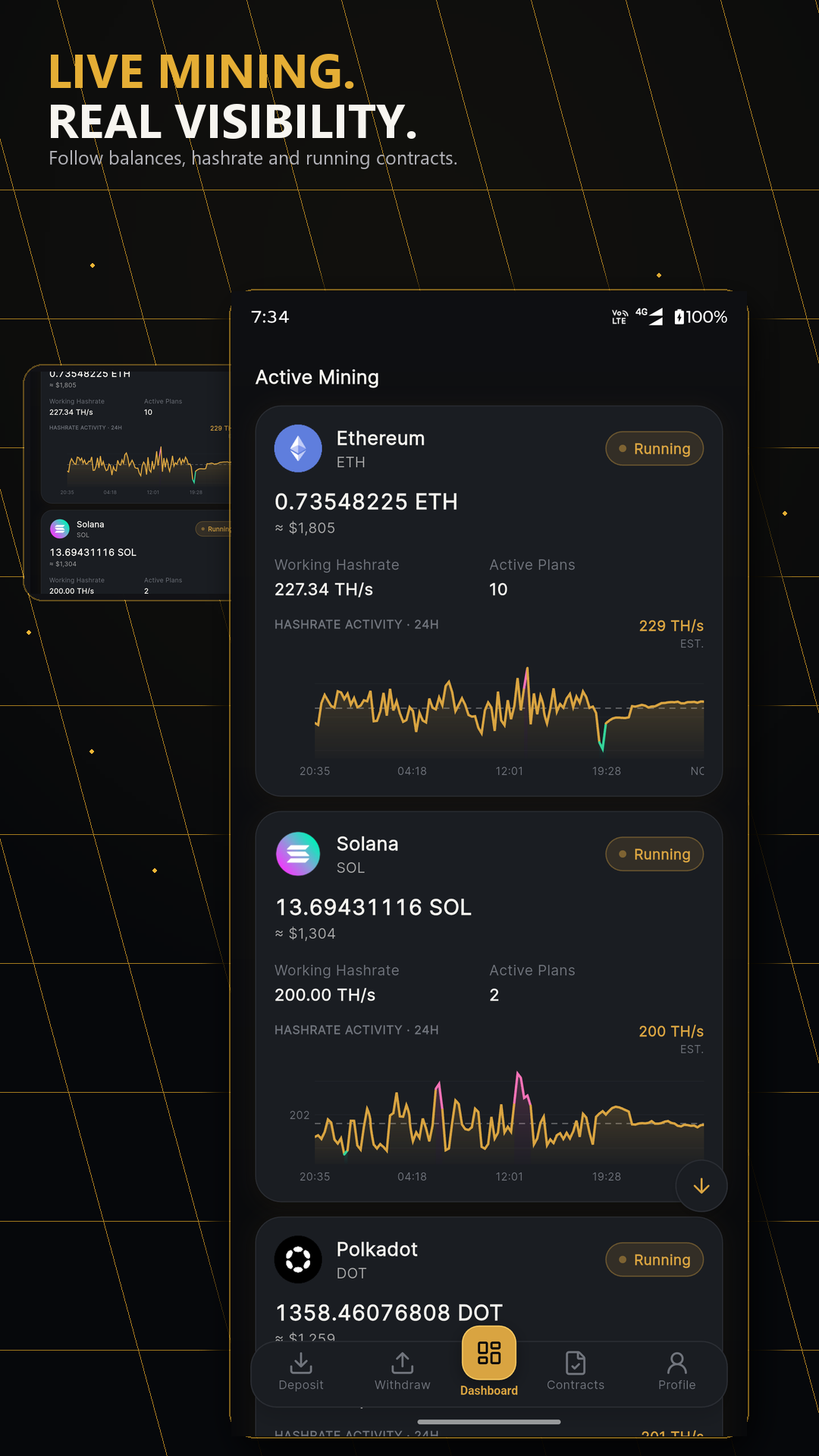
After activation, monitoring becomes the daily habit. Dashboards answer whether capacity is online and how credits behave under current conditions. They do not freeze network difficulty or market prices. Flat hashrate with falling expected coins is a common PoW reality when competition rises.
Cloud mining shifts CapEx and facilities burden away from the individual and toward contractual and counterparty dependence. CoinDrill’s educational tone acknowledges that trade-off. Convenience is real; guarantees are not. Risk disclosure and honest estimate language are part of a trustworthy experience, not optional footnotes.
- Learn concepts → read contracts → activate carefully → monitor status
- Hashrate is work rate; income remains conditional
- Cloud convenience trades against hardware control
Core product surfaces
Cloud Mining and Crypto Cloud Mining pages explain category positioning. Bitcoin Cloud Mining narrows to BTC workflows. Mining Contracts explain commercial packaging. The Mining Dashboard is the operational cockpit for status and hashrate signals when enabled.
Supported Assets pages give each coin a unique network overview and CoinDrill relevance section. Learn articles teach mechanisms without hard selling. Platforms pages clarify Web, Android, Windows, and iOS Coming Soon expectations.
Deposits and withdrawals, Rewards/Earn, referrals, security, FAQ, and legal/risk pages complete the operating manual around the mining core. Homepage messaging should point outward to those surfaces rather than compressing everything into slogans.
Hashrate allocation versus earnings allocation
Hashrate_allocation assets are PoW networks where remote capacity is meaningfully discussed as work rate against an algorithm. CoinDrill’s accuracy guidelines name Bitcoin (SHA-256), Dogecoin (Scrypt), Litecoin (Scrypt), Bitcoin Cash (SHA-256), Monero (RandomX), Ethereum Classic (Etchash), and Kaspa (kHeavyHash).
Earnings_allocation assets may still appear in a “cloud mining product” catalog style when enabled, but their blockchains are not PoW-mined on ASICs in the Bitcoin sense. Ethereum, BNB, Solana, Cardano, Avalanche, and Polkadot sit in PoS families; TRON is DPoS-style; XRP uses XRPL consensus. CoinDrill may offer product abstractions without rewriting those consensus facts.
Homepage and marketing copy should preserve that literacy. Blurring allocation classes creates the exact misconceptions Learn and asset pages exist to prevent.
Platforms and access
CoinDrill targets Web for browser access, Android for mobile management, and Windows for desktop management. iOS is communicated as Coming Soon where product materials say so. Across platforms, the rule is identical: clients manage; they do not secretly mine.
Cross-platform continuity matters for people who check contracts on a phone and review details on a desktop. Account state should be understood as service-backed rather than device-local mining state.
Platform pages exist so visitors can choose an entry point without assuming every OS build ships identical funding rails on day one — confirm in-app.
Risk posture and educational tone
CoinDrill’s longform voice is educational, not hard sell. It explains mechanisms, states uncertainties, and separates promotional Earn rewards from mining credits. It refuses invented balances, fabricated hashrates, and guaranteed APY theater.
Mining-related products are exposed to difficulty changes, fee drag, variance, outages, market drawdowns, and contract misreads. Cloud products add counterparty and reporting dependence. Honest pages name those risks.
Users should read risk disclosure before sizing activity, and treat Learn content as literacy — not as personalized financial advice.
- No guaranteed returns
- Estimates are informational
- Earn promotions ≠ mining output
How to explore CoinDrill from the homepage
Start with How It Works or Cloud Mining if you need the product loop. Start with What Is Cloud Mining if you need definitions. Start with Supported Assets if you care about a specific coin’s consensus context. Start with Platforms if you want the client for your device.
If you already understand PoW basics, jump to Mining Contracts Explained, then open live contract details. If you are comparing ownership models, read Cloud Mining vs Hardware Mining.
Wherever you enter, keep one sentence in mind: CoinDrill helps you manage remote and catalog-defined mining-related activity — it does not turn your personal hardware into a competitive miner.
FAQ
Does CoinDrill mine on my phone or PC?
No. CoinDrill does not use your phone or PC CPU/GPU for cryptocurrency mining. Clients are for management and monitoring.
What is the difference between hashrate_allocation and earnings_allocation?
Hashrate_allocation covers PoW assets with named algorithms where remote hashrate-style capacity is the natural lens. Earnings_allocation covers assets whose base consensus is not ASIC PoW; catalog offerings are product abstractions when present.
Which platforms are available?
Web, Android, and Windows for management. iOS is Coming Soon where product communications say so.
Are mining returns guaranteed?
No. Difficulty, fees, markets, uptime, and contract terms affect outcomes.
Where do I learn the basics?
Use the Learn Hub — especially What Is Cloud Mining, What Is Hashrate, and Proof of Work Explained.
Is every catalog asset mined like Bitcoin?
No. Only specific PoW assets use hashrate_allocation algorithms listed in CoinDrill accuracy guidelines. Others may be earnings_allocation offerings.
Explore CoinDrill
Cryptocurrency values, network conditions, mining output and related results may change over time. See the Risk Disclosure.